

Introduction
During the past 35 years (1976- October 2010) Europe (including Middle East) has been hit by 162 damaging earthquakes, which represents 20% of the damaging earthquakes worldwide. The earthquakes resulted in about 62,000 casualties (6.7% of the casualties of the whole planet) and an economic loss of 110,900 Millions of Euro. (EM-DAT, the OFDA/CRED International Disaster Database, www.em-dat.net). Although parts of Europe, the US and Japan have populations exposed to similar levels of high earthquake hazard, the relative vulnerability of the European population is some 10 times greater than in Japan, and 100 times that of the US. The protection of critical infrastructure and life-lines is one of the priorities of the EU. In order to counteract this potential vulnerability, the European Council requested in 2004 the development of a European Programme for Critical Infrastructure Protection (EPCIP). Since then, comprehensive preparatory work has been undertaken, which has been included in a Green Paper.
Preventive actions, such as retrofitting of structures and the diffusion of construction codes, are of course essential elements of a comprehensive earthquake disaster mitigation strategy. However, they are not sufficient and cannot be applied easily everywhere. In European cities a substantial proportion of the population living in areas of higher earthquake hazard still resides in older (historical) buildings that do not meet modern earthquake resistant standards, and cannot currently be strengthened in an economically viable manner. In many areas of high earthquake risk there are also cultural centres of great importance.
A feasible long term objective for Europe is reducing the individual vulnerability of its population to a level comparable to that of Japan and the US. The application of real time mitigation of earthquake risk, through actions focused to decrease physical vulnerability and exposure, has the potential of significantly contributing to this goal. These actions require the development and the use of probabilistic forecasting, (characterized by high probability gain and low absolute probability values), of early warning and rapid loss and damage evaluation, taking into consideration also the evolution in time of vulnerability and risk.
The Challenge
All the components of a real time earthquake risk reduction system are treated jointly and coherently using a system level approach for the first time in REAKT. The decision system developed in WP6 will include information from operational forecasting models (WP3), early warning systems (WP4 and 7), rapid alert systems (WP4) and real time identification of physical vulnerability changes (WP5). The reliability of operational forecasting and early warning will be improved by information on the dynamics of earthquake processes and transient phenomena provided by WPs 2 and 4. Using a system level approach all uncertainties along the real time risk mitigation chain can be carried through to the various end-users, where decisions need to be taken in light of the uncertain knowledge. Critical to the success of REAKT is also the need to view the performance of the entire system from an end user perspective, which is why targeted applications (WP7) and close integration of end-users through the end-user group (EUG) are integral elements of the REAKT work plan.
Objectives
The general objective of the Project is to improve the efficiency of real time earthquake risk mitigation methods and its capability of protecting structures, infrastructures and people. REAKT aims at establishing the best practice on how to use jointly all the information coming from earthquake forecast, early warning and real time vulnerability assessment. All this information needs to be combined in a fully probabilistic framework, including realistic uncertainties estimations, to be used for decision making in real time.
REAKT will use a system-level earthquake science approach that requires that the various temporal scales of relevance for hazard and risk mitigation in the various WPs are integrated through common tools, databases and methods.
The main specific objectives are:
- a better understanding of physical processes underlying seismicity changes on a time scale from minutes to months;
- the development, calibration and testing of models of probabilistic earthquake forecasting and the investigation of its potential for operational earthquake forecasting;
- the development of time-dependent fragility functions for buildings, selected infrastructures, and utility systems;
- the development of real time loss estimation models over the lifetime of structures and systems due to foreshocks, main shocks and their subsequent aftershock sequences.
- the construction of a detailed methodology for optimal decision making associated with an earthquake early warning system (EEWS), with operational earthquake forecasting (OEF) and with real time vulnerability and loss assessment in order to facilitate the selection of risk reduction measures by end users;
- the study of the content and way of delivering public communication, recognizing the value of a degree of self organization in community decision making;
- the application of real time risk reduction systems to different situations (trains, industries, hospitals, bridges, schools, etc.).
Partners
Principal investigator
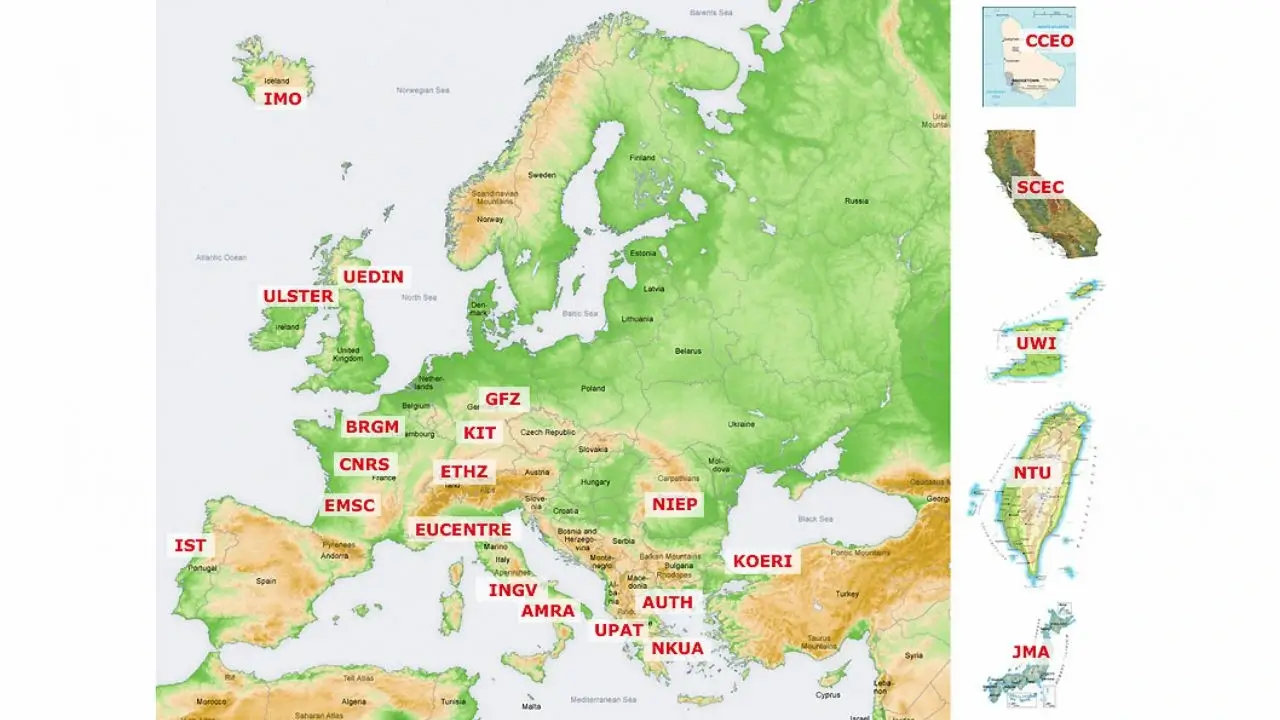
- AMRA - Prof. Paolo Gasparini
- GFZ - Prof. Jochen Zschau
- ETHZ - Dr. Stefan Wiemer
- BRGM - Prof. Hormoz Modaressi
- INGV - Dr. Warner Marzocchi
- AUTH - Prof. Kyriazis Pitilakis
- KIT - Prof. Friedemann Wenzel
- EMSC - Dr. Rémy Bossu
- EUCENTRE - Dr. Carlo Giovanni Lai
- IMO - Dr. Kristin Vogfjord
- CNRS - Prof. Pascal Bernard
- UEDIN - Prof. Ian Main
- IST - Prof. Carlos Oliveira
- KOERI - Prof. Mustafa Erdik
- NIEP - Dr. Gheorghe Marmureanu
- ULSTER - Prof. Sandy Steacy
- UPAT - Dr. Efthimios Sokos
- CCEO - Mr. Tony Gibbs
- SCEC - Prof. Thomas Jordan
- UWI - Dr. Richard Robertson
- NTU - Prof. Yih-Min Wu
- JMA - Dr. Mitsuyuki Hoshiba
- NKUA - Prof. Kostas Makropoulos

Marco De Luca
Author at Reakt Project
Marco De Luca writes clear and well-structured articles about technology and digital innovation.

Thomas Berger
Editor at Reakt Project
Thomas Berger works with data to identify patterns, trends, and insights that support technology-related projects.